

If you have a marketing budget and want leads or sales, you will quickly run into the same question almost every business owner asks: should I spend my money on Google Ads or Meta Ads (Facebook and Instagram)?
Both platforms can grow a business. They just work in very different ways. In this guide we break down how each one reaches customers, what it typically costs, which types of businesses do best on each, and how to decide where your first dollar should go.
The Core Difference: Intent vs. Interest
The simplest way to understand the two platforms is this:
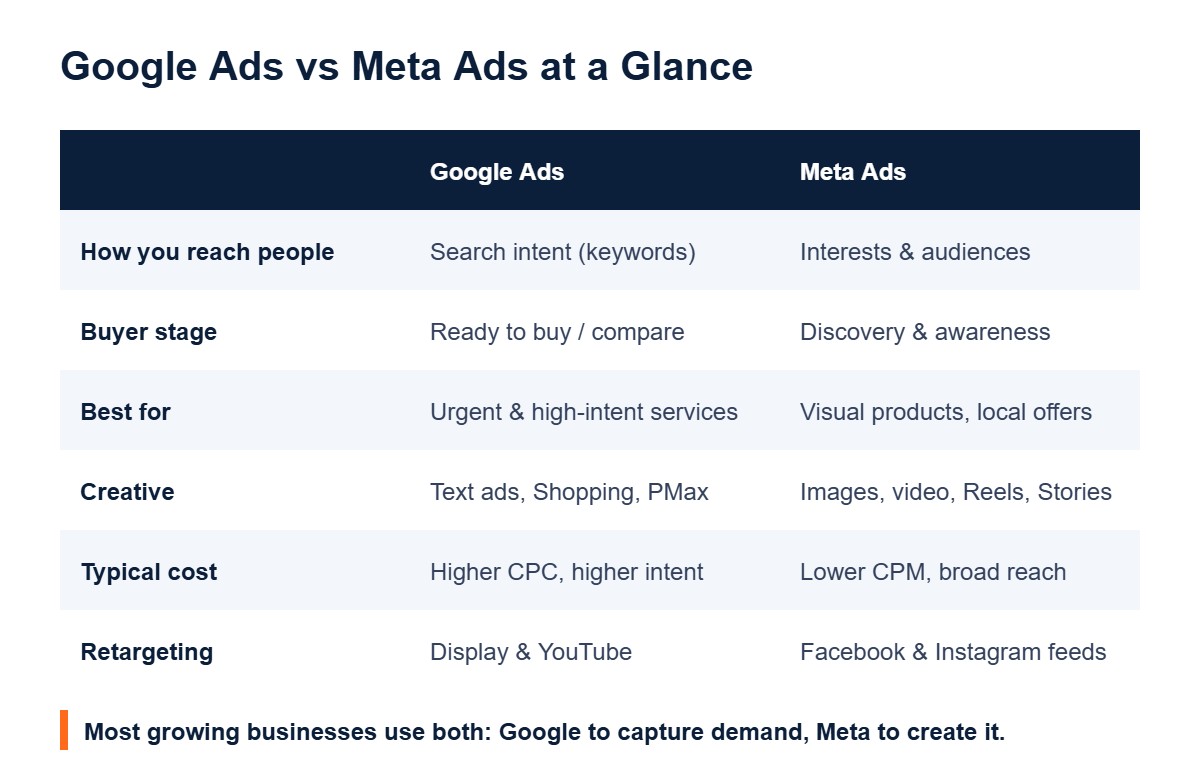
- Google Ads captures existing demand. People type what they want into Google (“emergency plumber near me”, “accounting software for small business”), and your ad appears at the moment they are looking.
- Meta Ads creates new demand. People scroll Facebook and Instagram to relax, not to shop. Your ad appears based on who they are and what they are interested in, before they were actively searching for you.
That one difference shapes everything else: cost per click, the kind of creative you need, how quickly you see results, and how you should measure success.
When Google Ads Is the Better Choice
Google Ads usually wins when your customers already know they have a problem and are actively searching for a solution. It is especially strong for:
- Urgent or high-intent services such as repairs, legal help, medical clinics and home services, where someone needs help now.
- B2B and considered purchases where buyers research and compare options before contacting a provider.
- Local businesses that want to appear when people search for a service in their area.
- Ecommerce brands using Shopping and Performance Max campaigns to show products with prices directly in search results.
The trade-off is cost. Because these clicks come from people who are ready to act, competitive keywords can be expensive. Good account structure, negative keywords and well-matched landing pages make a big difference to how far your budget goes. We cover what professional management includes in our guide to PPC management services.
When Meta Ads Is the Better Choice
Meta Ads tend to perform best when your product is visual, easy to understand quickly, or something people do not know to search for yet. They work well for:
- Consumer products such as fashion, beauty, home goods and food, where an image or short video sells the idea.
- New products or categories with little existing search volume.
- Local offers and events like a restaurant promotion, gym membership or open day targeted to people nearby.
- Building an audience you can retarget later with more direct offers.
Meta’s cost per thousand impressions is often lower than Google’s cost per click, so you can reach many people on a modest budget. The challenge is creative: ads must stop the scroll, and they need to be refreshed regularly as audiences get used to them.
Cost: What Should You Expect?
There is no single “average” cost that applies to every business, because prices depend on your industry, location, competition and the quality of your ads. As a general pattern:
- Google Ads usually has a higher cost per click but a higher chance that each click turns into an enquiry or sale.
- Meta Ads usually has a lower cost per click and impression, but more people will need to see your brand several times before buying.
The metric that matters is not cost per click; it is cost per lead or cost per sale, and ultimately return on ad spend. A more expensive click that converts can easily be cheaper than a low-cost click that never does.
Targeting: Keywords vs. Audiences
How Google Ads targets
You choose keywords that match what your customers search for, then refine by location, device, schedule and audience signals. Match types and negative keywords help you avoid paying for irrelevant searches.
How Meta Ads targets
You define audiences by location, age, interests and behaviours, or let Meta’s algorithm find buyers using broad targeting. You can also build custom audiences from website visitors or customer lists and lookalike audiences of people similar to your best customers.
Creative: What Each Platform Needs
On Google Search, your ad is mostly text. Success comes from clear, relevant headlines that match the search and a landing page that delivers what the ad promised. On Meta, creative is the main lever: strong images, short vertical videos, user-generated content and clear offers do most of the work. If your website is slow or confusing, both platforms will underperform, so it is worth making sure your website is built to convert.
A Simple Way to Decide
Ask yourself three questions:
- Are people already searching for what I sell? If yes, start with Google Ads.
- Is my offer visual or impulse-friendly? If yes, Meta Ads is a strong option.
- How long is my sales cycle? Short and urgent favours Google; longer, awareness-driven journeys benefit from Meta’s ability to reach people repeatedly.
For many businesses, the answer is both, used for different jobs. Google captures people who are ready to buy. Meta builds awareness and retargets visitors who did not convert the first time.
How to Use Google Ads and Meta Ads Together
- Retarget search visitors on social. Someone who clicked your Google ad but did not enquire can see a testimonial or offer on Instagram.
- Use social to grow branded search. As more people see your brand on Meta, more of them search for you by name, which is usually your cheapest and highest-converting traffic on Google.
- Share learnings. Winning messages from Google search terms can inspire social ad hooks, and top-performing social angles can improve your search ad copy.
- Track everything in one place. Set up conversion tracking (Google Tag, Meta Pixel and Conversions API) so you can compare platforms on real results.
If Meta Ads is part of your plan, organic social content makes your ads more effective. Our social media marketing playbook for small businesses shows how to build that foundation.
Common Mistakes to Avoid
- Sending ad traffic to your homepage instead of a focused landing page.
- Judging Meta Ads only by last-click conversions, which undervalues its role in awareness.
- Running Google Ads on broad keywords without negative keywords.
- Splitting a small budget across too many campaigns to learn anything.
- Launching without conversion tracking.
Getting Help With Paid Advertising
Choosing between Google Ads and Meta Ads is easier when you look at your own data. At RankVyn we plan, launch and optimise campaigns on both platforms, from search campaigns through our PPC advertising services to paid social through our social media marketing services. As a certified Google Partner, we focus on the numbers that matter: leads, sales and return on ad spend.
Not sure where to start? Contact our team for a free review of your current ads or a recommendation on where to invest first.
Frequently Asked Questions
Is Google Ads better than Facebook Ads?
Neither is better in every case. Google Ads is usually better for high-intent searches and urgent services, while Meta (Facebook and Instagram) Ads are usually better for visual products, awareness and retargeting.
Which is cheaper, Google Ads or Meta Ads?
Meta Ads typically have a lower cost per click and per impression, but Google Ads clicks often convert at a higher rate. Compare platforms on cost per lead or sale rather than cost per click.
Can a small business run both?
Yes. Many small businesses start with one platform, prove it works, then add the second. A common approach is Google Ads to capture demand and a small Meta retargeting budget to win back visitors.
How long does it take to see results?
Search campaigns can produce leads within days of launch, while both platforms usually need several weeks of data before they are fully optimised.
